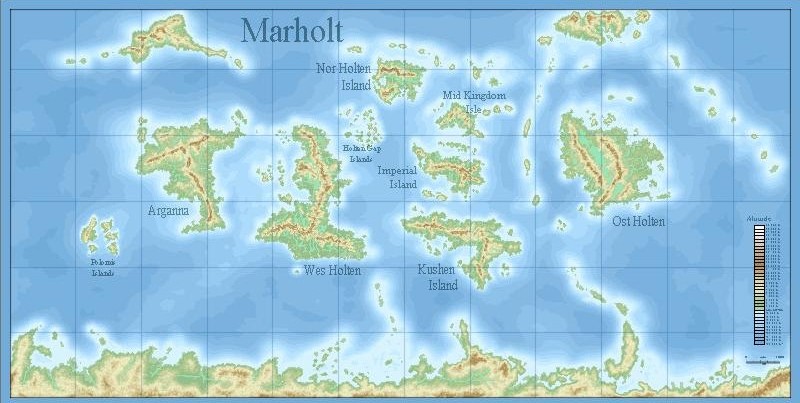
Introduction to Marholt
Marholt is similar to most other fantasy worlds. It is earth like in its climate, geography, flora and fauna and to a great deal, its history. What is different is where I believe it is different from most RPG fantasy worlds.
Elder Races and Demi-Humans:
Though almost everyone believes that the Elder Races and Demi-humans exist, most people have never seen one. And many that have, do not know it. Elves and dwarves look enough like humans that they are seldom recognized as such. Orcs, goblins and their cousins live so far removed from humans, that few have seen one.
Magic, yes and no:
Magic exists and works on Marholt. However, flashy powerful magic is rare. Most magic is small, simple spells. Think little old crone spoiling the Squires milk and not powerful mages calling up fireballs to destroy a castle. At the same time, most really powerful magic is very old.
Also, magic on Marholt is a crime for most of the churches. Practitioners can be charged with witchcraft. The punishment is based on the intent of the magic used, with fines or imprisonment for spoiling the squire’s milk to death for black magic.
Money:
All advanced cultures on Marholt use currency systems based on a silver coin, with each culture having its own name for its standard coin and any other coin it mints. And though individual names do exist, gold pennies, silver pennies, copper pennies, bronze pennies and tin pennies can be used to refer to each level of coinage. In all but isolated cases, each coin is worth ten of the coin below it. In this system, copper pennies are the most common coin.
Knights and Horses:
Though horses exist, they generally are not large enough to carry an armored human or are too docile to be used as a true warhorse. Also, no culture on Marholt developed the stereotypical feudal society. For these two reasons, there are no knights on Marholt, only soldiers. Soldiers are employees of the state or the person who pays them, though the payment can be in the form of land use. Take note, that this is still a financial transaction and not the same as a feudal system, as the payer most often is a boss, not a lord.
Alternative Fuel Sources:
Marholt has three alternative fuel or light sources other than wood; kern, tar and linol.
Kern is the Marholt version of coal. It is mined as an ore and can be cleaned and processed to create koke, a cleaner, longer and hotter burning version of kern.
Tar is similar to oil and is used to create light. It can be burned as is, but is smelly, smokey and produces an inferior light.
Linol is an oil that can be burned as is, but creates less light and more smoke and odor. It can be rendered, and burns with very little to no smoke or odor and produces a much brighter and steady light. It is the preferred lamp oil in churches and wealthy homes.
Marholt technology versus the Real World:
Marholt has elements of several Earth time periods. As some examples, Marholt has gunpowder, muskets and cannons. Ships on Marholt are on par with ships that sailed during the late 1500s to the mid-1700s. Wagons have pivoting tongues and the horse collar is in use. The moldboard plow is used as are two and sometimes three field crop rotation and the seed drill. In medicine, cleanliness is practiced, though germs and bacteria have not actually been discovered, some physicians know something is up. Medical knowledge is quite advanced and is well ahead of a Civil War surgeon, even if it cannot be explained.
Dates:
The inhabitants of Marholt use the Calendar particular to their country. Dates in most material are expressed in the local calendar and in Charon Reconning. This is done to centralize when events have taken place in relation to each other. For the GM, the history of Marholt has been broken down into Ages, but these are not known or used by the inhabitants of Marholt. They are employed for the players in general and the GM in particular to give an idea of how long ago an event occurred.
The Bad on Marholt versus the Bad in the Real World:
Marholt is a fantasy world though I have tried to make it realistic in regards to climate, geography, ecology and what not. But I did not want to recreate our world or the stereotypical RPG world. These are some of the things that I think make Marholt different:
Hunger:
Marholt has a plentiful food supply. That is not to say that everyone is eating like a king. Just that in general, everyone is eating enough, if not eating well and there are no unwashed masses living hand to mouth everyday of every month.
Disease:
There is nothing like cancer, MD or a host of other diseases on Marholt. In like case, I have chosen to limit birth defects to the less severe, both mentally and physically.
Evil Men:
There is no need for the BAU from “Criminal Minds” on Marholt.
That is not to say that there are not murderers or rapists on Marholt, but I have chosen to limit the depths of depravity. Details not needed; besides, enough evil is done with the best of intentions.
Religion vs Religion:
There are competing religions on Marholt, just as there are on Earth. The biggest difference is how they compete. On Earth and in its history, some religions preach against others. On Marholt, this is not the case. The different religions and their gods know of each other and acknowledge each other’s presence and religion. The gods and their religions do not preach against one another, they do not set their adherents against each other. These actions are the decisions of people, BAD people.
I know that this difference does not matter to the victim of religious violence. But it does inform on the motivation of the perpetrator and the tenants of each religion. And that is a difference.
About Maps:
The maps are meant to be representative, not specifically accurate. As the area mapped gets smaller, detail grows and accuracy increases, but complete accuracy is still not the goal.
Terrain is shown by symbols, while the dominant vegetation for any one map is designated by colour. Cities, towns, villages, hamlets, thorps, individual structures and complexes are represented by symbols on area maps.
On local maps buildings are depicted by symbols. Though the actual building may not be limited to the outline as shown, the size of the actual building will always somewhat coincide with the size depicted on the map.
Roads that appear on maps are signific both in size and importance. They are also usually quite old. However, they are in no way meant to be seen as the only roads. It can be taken for granted that any two communities that are next to each other are connected by some sort of road, trail or footpath.
In the same way, waterways depicted on the map are of significance, but should not be seen as the only waterways. Like roads that exist without being shown on the map, so do many waterways. Thus, it can be taken for granted that any community depicted in fact sits on or very near some source of fresh water; a stream, pond, etc.
Communities as shown exist to some degree where they are depicted. And like roads and waterways, do not represent all the communities that do exist. Between communities are steadings, homesteads, hamlets, thorps and what not.
Languages, Words, Names, Etc.
In creating Marholt, as any fantasy world, there comes a time when you have to start naming things. I figure there are two approaches to this. The first is the Tolkien Way, create your own language complete with vocabulary, grammar and the like. But, seeing as I often struggle with everyday English, I did not see this as a viable option. So, I have opted for the second method, steal from the real world. So, I have assigned different languages from the real world to different cultures in the fantasy world of Marholt. The following list is comprehensive, but is short of complete. As the world develops, some groups will become more detailed or specific.
Charon is French
Hispanya is Spanish.
The Free Cities are Arabic/Middle Eastern.
Maygar and Venenzia are Eastern Europe.
Mid-Kingdom is English, Scottish and Irish. Nor-Holt is Scandinavian and Dutch.
The Kushen Isle is African.
Wes Holt is Central and South American Native.
Ost Holt is North American Native
Arganna is Asian (primarily Chinese).
As I develop the world, some general affiliations will become more specific.
In World Titles and Such:
For various reasons, one of which is I am not a fan of made-up words for things that I then have to explain are the thing, names and titles of things. Think of them as having already been translated into English or whatever language is appropriate.
Some might call this lazy. I call it cutting out the middle man. I see no value in telling the party that Joe is the zamakarian when I then have to explain that a “zamakarian” is the village priest. And now, the party is starting a dictionary. Keep in mind, the character knows what the zamakarian is, but the player only knows through their notes. This idea is repeated in other areas as well, thus the mayor of the village is the Mayor and not the Protock. However, some exotic word usage is good, but in general it is restricted to instances where context negates the need to explain what a kimicatchin is.
 Rex's Playmobil and Campaign World